
This guide helps you compare service proposals. It does not rank companies or confirm that one method suits every property. The useful question is what a provider will inspect, recommend and document for your situation.
What does humane gecko exclusion mean?
Gecko exclusion means reducing access to indoor spaces through suitable building repairs and prevention. A humane plan should also explain how an animal already inside will be dealt with without deliberately injuring it or leaving it trapped during proofing work.
Removal, inspection and exclusion are different tasks. Moving an accessible gecko does not repair an open doorway; repairing a screen does not establish that every concealed area has been checked. Ask which tasks your quote covers.
Texas A&M AgriLife Extension’s house-gecko guidance prioritises exclusion from structures. It also explains that house geckos eat insects and can gather near lights where insects are present. Seeing one outside is not, by itself, evidence that the whole property needs treatment.
Does a gecko sighting require a service visit?
A single outdoor sighting, occasional indoor access and repeated activity in several rooms deserve different questions. Record where the animal was seen and whether the same doorway or window is involved. Describe what you observed rather than guessing a population size.
EPA’s integrated pest management principles put identification, monitoring and prevention before choosing controls. That is a useful way to evaluate a proposal: does it respond to evidence, or offer the same package regardless of the problem?
- One outdoor sighting: ask whether any intervention is necessary.
- An accessible animal indoors: discuss appropriate removal and how it entered.
- Repeated indoor sightings: request an entry-point and maintenance assessment.
- Activity in an inaccessible void: clarify inspection limits before approving dismantling or treatment.
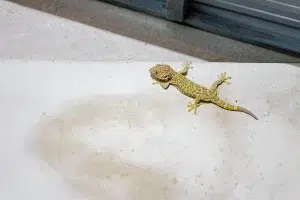
What should a gecko inspection cover?
Ask for an inspection that distinguishes observations from suspected routes. A photograph of a gap is useful, but the report should explain whether it is a likely access point, a maintenance defect or something needing further investigation.
University of California IPM guidance on lizard exclusion identifies openings around doors, windows, pipes and ventilation screens as areas to check. Suitable door seals and repairs can help reduce access. Its biological and regulatory context is Californian; do not apply a listed species, gap measurement or product rule automatically to an Abu Dhabi site.
Request a practical record that includes:
- The rooms and accessible exterior areas inspected.
- Sighting locations and any evidence photographed.
- Potential routes and the recommended action for each.
- Concealed or high-level areas that could not be checked.
- Repairs requiring your landlord or maintenance contractor.
Agree access before the visit. An ordinary room inspection should not be assumed to include opening ceilings, electrical work or specialist access equipment.
How can you assess the animal-handling approach?
Ask the provider to describe its proposed handling in plain language. If an animal can be reached, what method is appropriate for that animal and location? What happens if it is hidden, injured or cannot be identified confidently?
For a humane service, ask for a clear commitment against glue traps and deliberate injury. RSPCA Australia explains the welfare problems with glue boards, including distress, injury and harm to non-target animals. An adhesive board is not a humane capture-and-release method simply because it contains no poison.
Also ask how removal and repairs will be sequenced so an animal is not sealed into a space. Where relocation or specialist animal care is needed, the provider should explain the appropriate local route rather than improvising a release location.
You do not need to catch the animal before inspection. Keep children and pets from chasing it, share a photograph if available and avoid dismantling fixtures to retrieve it.
What should you ask about sprays, repellents and devices?
A product name is not an inspection plan. Ask what the proposed product or device is intended to do, what evidence supports that use and why it is needed alongside exclusion.
UF/IFAS Extension’s house-gecko management article discusses entry prevention and the connection between geckos and insect food sources. Its pesticide statements concern its own jurisdiction; they are not proof of UAE approval or prohibition.
If insect activity also needs attention, ask for a separate explanation of the target, method and precautions. Reducing insects is not the same as proving that gecko access routes have been repaired.
- Request product documentation for any proposed application and its intended local use.
- Ask for supporting evidence before accepting a repellent or ultrasonic-device claim.
- Confirm preparation and occupancy instructions for the actual work.
- Discuss children, pets, aquariums and relevant sensitivities.
Do not accept “natural,” “odourless” or “eco-friendly” as a substitute for those answers. Agree any additional work before it is added to the service.
How should you compare humane gecko service quotations?
Compare the work covered before comparing the total. A removal-only visit, an inspection report and a repair package are different deliverables. Ask each provider to separate them so you can see what is included.
| Quote item | What to clarify |
|---|---|
| Inspection | Areas covered, access limits, documentation and any inspection charge. |
| Accessible removal | Proposed handling, welfare measures and what happens if the animal cannot be reached. |
| Exclusion repairs | Named gaps or defects, materials, quantity of work and who completes it. |
| Additional work | Separate insect assessment, cleaning, specialist access or building repairs. |
| Follow-up | Whether a revisit is included, what triggers it and any written limits. |
A useful quote should also state what happens if inspection changes the proposed scope. Ask for approval of additions rather than relying on a vague promise of a complete package.
How do you check a provider’s claims without relying on rankings?
Use evidence you can review. Ask who will carry out the inspection, what relevant work they undertake and what documentation supports any claimed qualifications or authorisation. Do not infer specialist competence from a search position or an advertising badge.
Reviews can help you prepare questions, but a star rating does not explain the handling method or repairs included in your visit. Look for specific, verifiable information and request clarification of broad claims.
For any guarantee, obtain the wording before booking. Check the period, covered work, exclusions, customer responsibilities and remedy offered. Do not assume a free revisit, same-day appointment or permanent exclusion unless the provider confirms the actual terms.
Who completes repairs and checks the result?
Exclusion often needs coordination. In an apartment, access routes may involve common areas; in a villa, the relevant work may involve exterior doors or utility openings. Ask the provider and property manager to allocate each recommended repair to a named responsible party.
Confirm that repair details suit the building and preserve required ventilation, drainage and utility access. “Seal everything” is not an adequate specification.
Agree a handover record showing completed work, remaining defects and the next review point. If further sightings occur, note the location and date rather than assuming either total failure or a new infestation. A follow-up should check the evidence and any outstanding repairs.
How to request humane gecko exclusion in Abu Dhabi
Al Rabwa’s lizard and gecko control service in Abu Dhabi describes inspection, entry-point assessment and prevention. Use that page to discuss the approach for your property, and explicitly ask whether the proposed work meets your humane-handling requirements.
Send your location, property type, affected rooms, sighting history and any existing photos of the animal or openings. Explain access restrictions and whether the landlord or building manager must approve repairs.
Request a written scope separating inspection, any accessible removal, exclusion work and follow-up. Confirm availability and terms with the team; this guide does not establish a company ranking, price, booking promise or welfare certification.
Frequently asked questions about humane gecko services
Can geckos be managed without killing them?
An inspection can assess appropriate handling and exclusion options for the animal and property. Ask the provider to explain those options and explicitly exclude glue traps and deliberate injury. The agreed method should reflect identification, access and local requirements.
Does removal alone stop geckos returning?
Removal and exclusion are different tasks. Moving an accessible animal does not repair gaps or damaged screens. Ask which routes were identified, what repairs are included and how outstanding maintenance and further sightings will be reviewed.
Are glue traps a humane way to remove geckos?
No. Glue boards can cause injury, prolonged distress and harm to non-target animals. A trap being non-poisonous does not make it humane. Ask for another approach; if an animal is already stuck or injured, seek prompt veterinary or appropriate animal-care advice.
Can a provider guarantee permanent gecko exclusion?
Do not assume permanent exclusion. Ask for the exact written terms, covered repairs, exclusions and follow-up arrangements. Further access can depend on outstanding defects, shared building routes and maintenance, so the actual scope matters more than a broad guarantee.
What should I send before a gecko inspection?
Send the property type, Abu Dhabi location, affected rooms, dates or frequency of sightings and any existing photographs. Mention access restrictions, children, pets and repair permissions. Do not catch an animal or dismantle fixtures just to provide evidence.
How do I choose a humane gecko service in Abu Dhabi?
Compare the inspection scope, animal-handling approach, proposed repairs and written follow-up. Ask how the provider avoids injury and whether glue traps are excluded. Request evidence for company claims and confirm the specific work rather than choosing by an unsupported ranking.
Sources and scope of this guide
The linked university, animal-welfare and IPM resources support general biology, exclusion and welfare principles. They do not establish local species, UAE product approvals or a service provider’s qualifications. The quotation checklist is a practical way to ask for a defined, reviewable scope.
For provider information, read about Al Rabwa. For a property-specific enquiry, use the gecko inspection and control service page and state your humane-handling requirements.

